Daily English Speaking Practice: A 15-Minute Routine That Sticks
The most effective daily English speaking practice is short, spoken, and structured: 2 minutes of warm-up self-talk, 10 minutes of real conversation, and 3 minutes drilling the words you got wrong. Fifteen minutes a day outperforms a two-hour weekly class because speaking fluency is built on frequency, not duration. Here is the routine, and how to make it a habit you keep.
Why daily beats intense
Speaking English draws on fast recall — words and structures surfacing in milliseconds. Recall strength decays between practice sessions, so seven short sessions a week keep your English "warm" while one long session lets it cool for six days in between. This is why learners who switch from a weekly class to daily 15-minute practice routinely feel more progress in a month than in the previous year.
The 15-minute daily routine
-
1 Minutes 1–2: Warm up out loud
Say what you did today or plan to do, in English, out loud. This shifts your brain into English mode and costs nothing.
-
2 Minutes 3–12: One real conversation
Have an actual back-and-forth conversation — with an AI coach, a partner, or a tutor. Pick a topic tied to your life and aim to speak at least half the time. This block is where fluency is built; protect it.
-
3 Minutes 13–15: Drill your misses
Take the words or phrases you fumbled in the conversation and drill them: listen to the correct model, repeat until clean. Ending with focused correction converts today’s mistakes into tomorrow’s fluency.
-
4 Weekly bonus: One review session
Once a week, re-run your hardest recent scenario and compare how it feels. Visible progress is the fuel that keeps a daily habit alive.
How to actually stay consistent
- Anchor practice to an existing habit: right after morning coffee, or during the commute.
- Make it frictionless: practice from your phone, so "no partner / no time / not at my desk" can’t become excuses.
- Never miss twice: skipping one day is noise, skipping two starts a new habit of not practicing.
- Track something visible: accuracy scores or a streak — progress you can see is the strongest motivator to continue.
- Keep sessions short on bad days: a 5-minute conversation on a busy day preserves the habit; perfectionism kills it.
Run your daily routine in Vaani
Vaani is built for exactly this kind of daily practice: conversations start in seconds, feedback is instant, and your weak words are collected for you — the whole routine lives in one app.
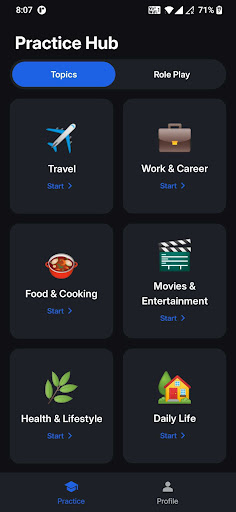
- 1 Open Vaani and start your 10-minute conversation immediately — pick a different Practice Hub topic each day (Daily Life Monday, Work & Career Tuesday, Travel Wednesday…) to keep vocabulary broad.
- 2 Speak freely with hold-to-speak; the AI teacher keeps the conversation going, so your 10 minutes are pure speaking practice.
- 3 Finish with Words to Practice: your mispronounced words from today’s session are already collected — drill each one with Listen and repeat until the accuracy score is green.
- 4 Because Vaani is available 24/7, your routine survives busy days: five minutes at midnight still counts.
- 5 Watch your accuracy trend upward across sessions — the visible progress that makes the habit self-sustaining.

Free to start · Available 24/7