English Interview Speaking Practice: Questions, Sample Answers and a 5-Day Plan
By Ajay Mourya · Updated
The fastest way to stop freezing in an English job interview is to rehearse your answers out loud, not on paper. Speak the questions you will actually be asked until your answers flow, and fix the grammar and pronunciation slips that make you nervous. This guide gives you the 10 questions to practice, sample answers for IT roles, phrases for when your mind goes blank, and a 5-day plan to get ready.
Why your English disappears in interviews
Under pressure, your brain puts its effort into what you are saying, and your English, the less automatic skill, is the first thing to slip. That is why candidates who read and write English comfortably still stumble in interviews: they have rarely spoken professional English out loud with someone waiting for the answer. Rehearsal fixes this. An answer you have spoken ten times comes out smoothly even when you are nervous, because you no longer have to build it word by word.
If nervousness is the bigger problem for you, start with our guide on speaking English confidently without fear.
The 10 interview questions to practice speaking
Whether you are interviewing for a fresher role at an IT services company or a developer job at a product startup, most interviews draw from the same small set of questions. Prepare spoken answers for these and you have covered most of the conversation. The first five have sample answers below.
- "Tell me about yourself"
- "Why should we hire you?"
- "What are your strengths and weaknesses?"
- "Tell me about a challenge you faced and how you handled it"
- "Why do you want to join this company?"
- "Where do you see yourself in five years?" Show ambition that fits the company: "I’d like to be leading a small team and owning a module end to end."
- "Why are you leaving your current job?" Stay positive. Talk about the growth you want, never complaints about your manager or team.
- "What are your salary expectations?" Research the range for the role first, then give a range: "Based on my research, I’m looking for X to Y lakh per annum, but I’m open to discussing the full package."
- "Can you explain this gap in your resume?" Give one honest sentence about the reason, then move to what you did to stay current, such as courses or projects.
- "Do you have any questions for us?" Always say yes, and prepare two, such as "What does the first month look like for someone in this role?"
Use the sample answers as a structure, not a script. Paragraphs memorised word for word crack under pressure, while a clear structure holds. Put your own details in, then practice saying your version out loud until it sounds like you.
"Tell me about yourself": sample answers for IT roles
This is almost always the first question, and it sets the tone for the rest of the interview. Use a simple present, past, future structure: who you are now, one or two things you have done that prove it, and what you want next. Keep it to 60 to 90 seconds when spoken.
Hi, I’m Rahul. I recently completed my B.Tech in Computer Science, and I graduated in 2025.
In my final year, I worked with two classmates on a library management web app using React and Node.js. I handled the backend and the database, and it showed me how much I enjoy solving problems for real users. I also did a two-month internship where I wrote test cases for a payments module.
Now I’m looking for a software engineer role where I can keep building my backend skills, and that’s why this position caught my attention.
Hi, I’m Sneha. I’m a QA engineer with three years of experience. I currently work at an IT services company in Bengaluru, where I test web and mobile apps for a retail client.
Over the last year, I moved our regression suite from manual testing to automated tests with Selenium and Java, which cut our release testing from three days to one.
I’m now looking for a role with more ownership of test automation, and your team’s focus on product quality is a big reason I applied.
For 10 more samples, including 30-second and video interview versions, see our guide to self introduction in English for interview.
"Why should we hire you?"
Connect what you can do to what the role needs, and back it up with one example. Avoid lists of adjectives like "hardworking and dedicated" with no proof; every candidate says them.
You need someone who can pick up your stack quickly and work well in a team. For my final-year project, I learned Node.js from scratch in about three weeks and then built the entire backend. During my internship, I worked in a team of six and learned to write code that other people review and maintain.
I can’t claim years of experience, but I learn fast, I take feedback well, and I’m genuinely interested in the kind of products you build.
"What are your strengths and weaknesses?"
Pick one strength and prove it with an example. For the weakness, choose something real that does not disqualify you for the role, and show what you are doing about it. Skip "I’m a perfectionist"; interviewers hear it every day.
My biggest strength is debugging. When something breaks, I stay calm and work through it step by step. During my internship, I was often the person teammates came to when a test kept failing.
A weakness I’m working on is speaking up in meetings. I used to stay quiet even when I had ideas. Now I write down one point before each meeting and make sure I share it, and it’s getting easier every week.
"Tell me about a challenge you faced"
Use the STAR structure: Situation, Task, Action, Result. Keep the situation short and spend most of your time on what you did. Interviewers want to hear "I", not only "we".
Two days before a client demo during my internship, our login feature started failing for some users. My task was to find the cause.
I went through the logs, reproduced the issue, and found that session tokens were expiring too early on one server. I fixed the configuration and added a test so the problem would not come back.
The demo went ahead on time, and my manager asked me to document the fix for the rest of the team.
"Why do you want to join this company?"
Spend ten minutes researching the company before the interview and mention something specific: its products, technology, training or growth. A generic answer ("It’s a reputed company") tells the interviewer you did not prepare.
I read about how your engineering team moved to a microservices setup, and I want to work somewhere that takes engineering quality seriously. I also like that freshers here work on client projects early, because I learn best by doing real work. And your training program in cloud technologies matches exactly where I want to grow.
Phrases to use when you freeze
Everyone blanks at some point in an interview. What matters is having a phrase ready so the silence does not turn into panic. Practice these until they come out automatically:
| Situation | What to say |
|---|---|
| You need time to think | "That’s a good question. Let me think about it for a moment." |
| You didn’t catch the question | "Sorry, could you repeat the question, please?" |
| You’re not sure what they mean | "Just to make sure I understand, do you mean…?" |
| You made a mistake mid-sentence | "Sorry, let me put that another way." |
| You don’t know the answer | "I haven’t worked with that yet, but here’s how I would approach it." |
| Explaining your thinking in a technical round | "My first idea is to…, but let me check the edge cases." |
| Finishing an answer | "So that’s how I handled it." |
Common Indian English mistakes in interviews
Many of these phrases are normal in Indian English, and any Indian interviewer will understand them. But if you are interviewing with a global company, a foreign client or an interviewer outside India, the standard forms sound more polished:
| Instead of | Say | Why |
|---|---|---|
| "I am having 3 years of experience." | "I have 3 years of experience." | "Have" meaning "own" is not used in the -ing form. |
| "I passed out in 2025." | "I graduated in 2025." | Outside India, "passed out" means fainted. |
| "Myself Rahul." | "I’m Rahul." or "My name is Rahul." | "Myself" cannot be the subject of a sentence. |
| "My good name is Rahul." | "My name is Rahul." | "Good name" is a translation from Hindi and sounds unusual to international listeners. |
| "I have completed my B.Tech in 2025." | "I completed my B.Tech in 2025." | With a specific past year, use the simple past. |
| "I will revert back to you." | "I’ll get back to you." | "Revert" means to return to an earlier state, and "revert back" repeats itself. |
| "Please do the needful." | Name the action: "Please send me the offer letter." | The phrase is unclear to people outside India. |
Speaking exercises to do before the interview
-
1 Record and review
Record your answer on your phone, listen back once, and fix one thing at a time: a filler word, a grammar slip, or a sentence that runs too long.
-
2 The 60-second timer drill
Set a timer and deliver "tell me about yourself" in 60 to 90 seconds. If you finish too early, add one example. If you run over, cut until it fits.
-
3 Drill the words you will definitely say
Your job title, your tools (Kubernetes, PostgreSQL, Selenium), your college and the company name. Mispronouncing these is distracting, so practice them until they are automatic. Our pronunciation guide shows how.
-
4 Explain one project out loud
For technical rounds, practice explaining a project in plain English: what it does, your part in it, and one problem you solved. Interviewers judge how clearly you explain, not only what you built.
-
5 Run a mock interview with follow-up questions
Ask a friend, or use an AI interviewer, to ask questions in random order with follow-ups like "Why did you choose that approach?" Nothing else comes as close to the real pressure.
A 5-day English mock interview plan
-
1 Day 1: Draft your answers out loud
Don’t write scripts. Speak each answer freely three times, using the structures above; it will tighten naturally.
-
2 Day 2: Fix the language
Practice your answers with a feedback source and clean up recurring grammar mistakes and mispronounced words, especially the technical vocabulary you will definitely need.
-
3 Day 3: Run a full mock interview
Simulate the real thing from start to finish: unpredictable question order, follow-up questions, no pausing. This is where practicing with an AI interviewer helps most.
-
4 Day 4: Drill your weak spots
Re-run only the questions that went badly. Drill mispronounced words individually until they are automatic.
-
5 Day 5: Light rehearsal and rest
Do one relaxed run-through of "tell me about yourself" and your two hardest questions. Confidence on the day comes from knowing you have already had this conversation.
Interview tomorrow? Spend one focused hour: say "tell me about yourself" five times with a timer, run one full mock interview, and drill the three words you stumble on most. Then rest.
Interview rounds in India: what changes in each
- HR round: expect "tell me about yourself", strengths, relocation and salary. Clear, confident answers matter more than complex vocabulary.
- Technical round: you will explain code, logic or past projects in English. Think out loud in short sentences, and say when you need a moment.
- Group discussion, common in campus placements: speak early, build on other people’s points ("Adding to what Priya said…"), and offer a summary at the end if no one else does. Good points beat talking the most.
- Phone and video interviews: the interviewer cannot read your body language, so speak a little slower than usual, pause between points, and test your microphone before the call.
- Managerial or client round: expect situational questions such as "What would you do if a deadline was at risk?" Answer with the STAR structure.
How to run mock interviews with Vaani
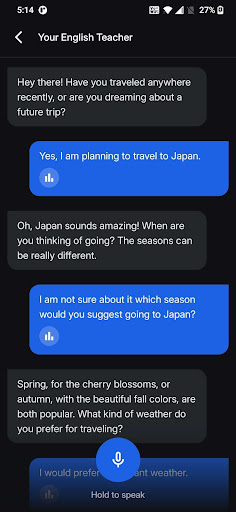
Vaani’s Role Play mode and Work & Career topic let you rehearse interview English in a real back-and-forth voice conversation, with corrections after every answer and none of the embarrassment of practicing in front of a person.
- 1 Open the Practice Hub, switch to Role Play, and choose an interview scenario, or pick the Work & Career topic for professional conversation practice.
- 2 Answer the AI interviewer’s questions out loud using hold-to-speak, including unexpected follow-ups, just like a real interview.
- 3 Review your accuracy score and instant corrections after each answer: grammar slips, mispronounced words, and stronger word choices.
- 4 Drill the specific words that tripped you up. Say your key vocabulary (your job title, your skills) until the accuracy score shows they are clean.
- 5 Repeat the scenario daily before your interview. Each run gets smoother, and you walk in having already practiced the conversation many times.

Free to start · Available 24/7