How to Speak English Fluently: 10 Steps That Actually Work
To speak English fluently, you need to speak — out loud, every day — not study more grammar. Fluency is a physical skill like swimming: it is built through repetitions of real conversation, quick feedback on your mistakes, and gradually thinking in English instead of translating. Here is a step-by-step plan that works even if you have nobody to practice with.
Why you understand English but still can’t speak it
Most learners have years of passive English — reading, listening, watching movies — but very few hours of active speaking. Understanding and speaking are stored as different skills in your brain. Reading another grammar book strengthens the skill you already have; only speaking builds the one you are missing. That is why someone who scores well on written tests can still freeze in a real conversation.
10 steps to become fluent in English
-
1 Speak out loud every day, even alone
Ten to twenty minutes of daily speaking beats a two-hour class once a week. Narrate what you are doing, describe your day, or talk with an AI conversation partner. The muscle memory of forming English sentences aloud is the foundation of fluency.
-
2 Learn phrases, not isolated words
Fluent speakers retrieve ready-made chunks — "I was wondering if…", "It turns out that…" — instead of assembling word by word. Collect full phrases from conversations and reuse them.
-
3 Stop translating in your head
Translating from your native language is the biggest cause of hesitation. Practice thinking directly in English: name objects around you, plan your day in English, and keep sentences short so you don’t need to translate.
-
4 Get feedback on every mistake — fast
Mistakes you never notice become permanent habits. The fastest improvers get corrections immediately after speaking, while the sentence is still fresh in memory.
-
5 Practice real-life scenarios, not textbook dialogues
Rehearse the conversations you will actually have: job interviews, ordering food, small talk with colleagues, travel situations. Scenario practice transfers directly to real life.
-
6 Shadow native speakers
Listen to a sentence and repeat it immediately, copying the rhythm, stress, and intonation. Shadowing trains your mouth and your ear at the same time.
-
7 Record yourself and listen back
You cannot fix what you cannot hear. Recording reveals the gap between how you think you sound and how you actually sound — and shows your progress over weeks.
-
8 Accept mistakes as the method, not the enemy
Fluency is not perfection. Native speakers make grammar slips constantly. Every mistake you make and correct in practice is one you won’t make in the moment that matters.
-
9 Make it easy to show up
The best practice method is the one you actually do. Remove friction: no scheduling, no partner coordination, no commute. If you can practice from your phone in five spare minutes, you will practice far more often.
-
10 Track your progress
Fluency grows too slowly to feel day-to-day. Accuracy scores, streaks, and a list of words you’ve mastered make progress visible and keep you motivated through the plateau.
How long does it take to speak English fluently?
With consistent daily speaking practice, most learners feel a clear difference in 4–6 weeks: less hesitation, faster sentence formation, more confidence in familiar topics. Conversational comfort in most everyday situations typically takes 3–6 months. The variable that matters most is not talent or living abroad — it is how many minutes per week you actually spend speaking.
How to build fluency with Vaani
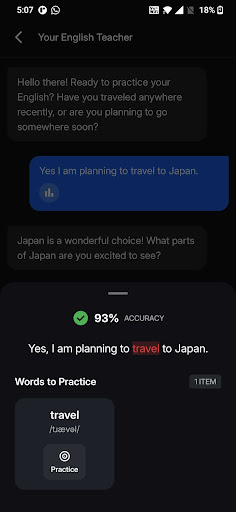
Vaani is an AI English speaking coach built around exactly this loop: speak in real scenarios, get corrected instantly, and repeat — with zero judgment and no scheduling.
- 1 Open the Practice Hub and pick a topic you’ll actually use — Travel, Work & Career, Daily Life, Food & Cooking, and more.
- 2 Hold to speak and have a real voice conversation with your AI English teacher. It responds naturally and keeps the conversation going.
- 3 After each sentence, see your accuracy score and instant corrections for grammar, pronunciation, and word choice — then try the sentence again.
- 4 Drill the specific words you missed in Words to Practice, with the correct pronunciation to listen to and imitate.
- 5 Come back daily — Vaani is available 24/7, so your practice never depends on anyone else’s schedule.

Free to start · Available 24/7